
AUDIO ORIGAMI JOURNAL
Pro Tips
Cartridge or tonearm.
What matters most?
Think of your favourite meal. Not the restaurant, not the crockery. The dish itself, and what made it memorable. The chances are it comes down to two things: the quality of the ingredients, and the skill of the chef who brought them together.
That is a surprisingly useful way to think about your analogue front end.
The cartridge is the ingredients. The tonearm is the chef. The turntable is the plate.
The cartridge is king.
When people describe the character of their vinyl setup, they are almost always describing their cartridge… warm or analytical, lush or precise, full-bodied or forensic. These qualities live in the cartridge because the cartridge is the transducer, the single component that converts the physical modulations in the groove into an electrical signal. Everything downstream is simply handling what it produces.
This is why cartridge choice is so personal, and why experienced listeners will spend serious money getting it right. The cartridge is where the flavour is. It is where your taste, your preferences, and your musical priorities are expressed. No amount of money spent elsewhere will replicate what it does.
The cartridge is king. But even the finest ingredients need a great chef.
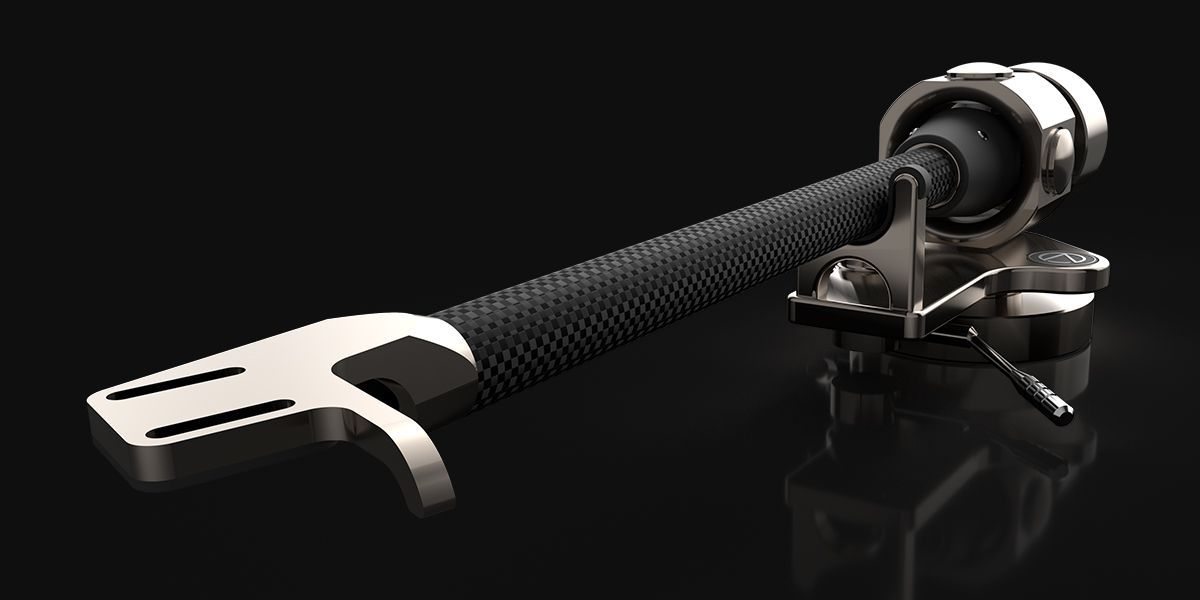
The tonearm is the chef.
A great chef does not just cook. They understand their ingredients, they create the right conditions for the flavours to develop, and they bring everything together on the plate in a way that lets the best qualities of each component shine. Take the same ingredients and put them in lesser hands, and you will get a lesser dish, regardless of their quality.
The tonearm works in exactly the same way.
Its job is to give the cartridge the conditions it needs to perform. It manages the resonant relationship between its own effective mass and the cartridge’s compliance. It controls how energy generated during playback is absorbed and dissipated rather than reflected back to the stylus. It carries the cartridge’s tiny electrical signal, typically less than half a millivolt in a moving coil design, from the headshell to the phono stage without degrading it along the way.
None of that is passive. None of it is trivial.
A cartridge fitted to a poorly damped arm is working against itself. Energy that should be absorbed bounces back through the cantilever, smearing transients and obscuring the fine detail the cartridge is capable of retrieving. A more expensive, higher-resolution cartridge in this situation will often sound worse because greater sensitivity means greater sensitivity to everything, including the arm’s shortcomings. The ingredients are exceptional. The conditions are not. The dish suffers accordingly.
A great tonearm does the opposite. It takes everything the cartridge provides and brings it together on a stable, quiet, neutral platform, letting the full character of the cartridge come through cleanly and completely. It does not add its own flavour. It makes sure nothing is lost.
This is why the tonearm is so frequently the missing piece in an upgrade decision. Listeners tend to think in two directions: a better cartridge or a better turntable. The tonearm sits between those two choices and is overlooked far more often than it should be. A better tonearm will not just improve what your current cartridge does, it will improve what every cartridge you ever fit to it does, now and in the future.
The turntable is the plate.
The turntable is the most visible part of the analogue front end. It sits on the shelf, it has a plinth and a platter and a motor and a bearing assembly, and the high-end ones are objects of considerable beauty. It is easy to assume that all of that engineering is where the character comes from.
The truth is more nuanced. The turntable’s job is to rotate the record at a stable, consistent speed without introducing noise or vibration into the system. That is not a trivial ask. Physics matters here. A well-designed plinth controls resonance. A precision bearing keeps the platter stable. A properly isolated motor keeps its own vibrations away from the stylus. Get these things wrong, and the whole system suffers, regardless of what sits on the armboard.
It is also worth understanding why turntables cost what they do. A tonearm is a precision mechanical instrument, but it is relatively compact and focused in what it requires. A turntable involves considerably more: heavy platters machined to tight tolerances, bearing assemblies engineered for near-silent operation, plinths built from materials chosen specifically for their resonance characteristics, and motors isolated and regulated to maintain consistent speed. The bill of materials is substantial, and in most cases, the price reflects genuine manufacturing cost rather than margin. Good turntables are expensive to make.
But beyond a reasonable level of competence, additional investment in the deck returns considerably less than the same money directed at the tonearm and cartridge.
So the plate matters. It just doesn’t meaningfully change the flavour of what is on it.
Where does this leave your upgrade decision?
If you are thinking about improving your analogue setup, start by asking whether your tonearm is giving your cartridge the conditions it deserves. In many systems, it is not. The cartridge is providing the ingredients. The turntable is holding the plate steady. But without a chef who can bring it all together, you will never quite taste what you paid for.
