
AUDIO ORIGAMI JOURNAL
Pro Tips
Tracking Force
Getting It Right Easily
Of all the adjustments involved in setting up a tonearm correctly, tracking force is the one most likely to be underestimated.
Get it wrong, and you’re not just leaving performance on the table; you’re potentially doing real damage. Too light and the stylus mistracks, skating across groove walls rather than tracing them, generating distortion and grinding away at vinyl with every revolution. Too heavy and you’re loading the cantilever and suspension beyond their design limits, accelerating wear on both the stylus and your records in a way that’s invisible until it isn’t. The difference between those two failure modes might be less than half a gram, which is exactly why measuring it properly isn’t optional; it’s the basic cost of entry for anyone serious about analogue replay.
Why tracking force deserves more respect…
Tracking force isn’t just about whether your cartridge stays in the groove. It determines the precise geometry of the stylus in relation to the vinyl, the angle of the cantilever, the way the suspension is loaded, and the contact patch between stylus and groove wall. Get it right, and the cartridge operates exactly as its designer intended. Drift outside the specified range, and you’re introducing distortion, changing the VTA dynamically, and depending on which direction you’ve drifted, either mistracking on peaks or accelerating stylus and record wear through excessive downforce.
Cartridge manufacturers specify a tracking force range for a reason, and they specify a recommended point within that range for a reason too. That number is where the suspension compliance, the cantilever geometry, and the stylus profile all converge to their optimal relationship. It’s not a suggestion, it’s an engineering requirement.
A tenth of a gram either way from the recommended figure might seem like splitting hairs. On a high-output moving-magnet cartridge, it probably is. On a low-output MC with a fine-line or Shibata stylus, it’s the difference between the cartridge performing as designed and something subtly but audibly wrong. The more refined the stylus, the more precisely it needs to be set up.
Why counterweights don't have force scale markings…
There's a good reason most tonearm counterweights carry no calibrated scale, and it's not an oversight. Cartridge bodies vary considerably in mass (sometimes by several grams across different models), so any markings on a counterweight would be accurate only for one specific cartridge at one specific position along the thread. For every other combination of arm and cartridge, they'd be wrong. Tonearm designers know this, which is why the better approach has always been to balance the arm to zero and then measure the actual downforce directly rather than infer it from the counterweight position.
The implication is straightforward: regardless of what tonearm you're using, you cannot know your tracking force without measuring it. Intuition gets you into the ballpark. A scale gets you where you need to be.
What you actually need…
A good digital cartridge scale. That’s it.
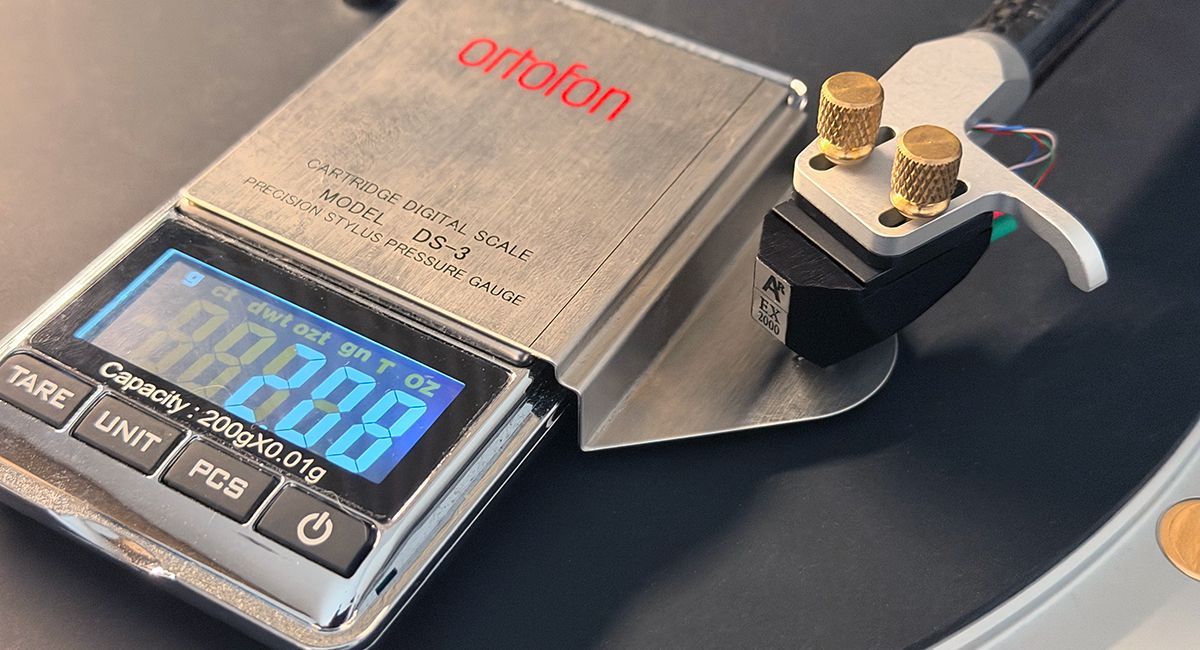
The Ortofon DS-3 Stylus Pressure Gauge* is our go-to recommendation for good reason. It’s designed specifically for this purpose, it measures at record level – which is important, because the stylus should be loaded at the height it actually operates – and it’s accurate to 0.01g.
The technique is straightforward. With the tonearm correctly balanced to zero, place the scale on the platter, gently lower the stylus onto the platform and. Read the figure. Adjust the counterweight until you hit your target, then check it twice. Importantly, do this before you align the cartridge, not after. Alignment involves physically adjusting the cartridge in the headshell, and any movement at that stage can shift the counterweight position enough to affect downforce. Get your tracking force in the right ballpark first, complete your cartridge alignment, then remeasure and fine-tune. It adds two minutes and removes a variable that's easy to overlook.
A few things that matter more than people realise…
Level surface. The scale needs to sit flat. A platter that’s fractionally off-level will give you a reading that’s fractionally wrong. Set your turntable level first, every time.
Anti-skate off. Anti-skate applies a lateral force to the arm. Leave it engaged during measurement, and it will affect your reading. Disengage it, set tracking force, then reapply anti-skate.
Stylus cleaner first. A dirty stylus reads slightly differently from a clean one, and you want the measurement to reflect real operating conditions. A quick pass with a stylus brush before measuring costs nothing.
Repeat the measurement. Lower, read, raise. Lower again, read again. If the two readings agree, you’re done. If they don’t, find out why; an inconsistent reading usually means a levelling issue or something touching the arm during measurement.
The 0.1g question...
Is 0.1g meaningful? Sometimes yes, sometimes no.
For the majority of cartridges in normal use, being within 0.05g of the manufacturer’s recommended figure is effectively perfect. The suspension tolerances in most cartridges are wider than that. You’re not leaving performance on the table.
Where it starts to matter more is at the extremes of cartridge design – ultra-low-compliance MCs, exotic stylus profiles, and cartridges with very tight specified ranges. Here, the precision a good digital scale provides becomes genuinely audible. Not in a subtle, audiophile-placebo way. In an audible, consistent, repeatable way.
The simple case...
There’s a tendency in high-end audio to assume that better results require more expensive tools. Tracking force is one of the clearest counterexamples to that assumption. Good cartridge scales operating at the correct height, and a repeatable process you can return to every time you change a cartridge.
Set it properly, check it every time you change cartridges, and revisit it every few weeks as a matter of habit. Tracking force can drift slightly over time as the counterweight settles, and two minutes with a scale is all it takes to be certain. It's one of the highest-return adjustments in analogue replay, and one of the cheapest and easiest to get right.
*Audio Origami recommend the Ortofon DS-3 Stylus Pressure Gauge. It is one of the few scales designed to measure tracking force at record height, which matters more than most people realise; a stylus loaded at the wrong height will behave differently on the platter. It's not the cheapest tool on the market, but it's precise, purpose-built, and will last a lifetime.
