
AUDIO ORIGAMI JOURNAL
Do Audio Cables Really Make a Difference?
We debunk the myths with fact...
Few topics in hi-fi provoke as much disagreement as cables. Mention them and you will usually encounter two opposing camps, those who insist cables can transform a system, and those who claim all cables sound identical and anyone hearing differences is fooling themselves.
Both positions miss the point.
This article deals only with analogue audio cables, not digital interconnects or network links. Within that context, the reality is straightforward. Cables can make a difference, but not always, not equally, and rarely in the dramatic ways they are often described.
To understand when and why those differences can occur, it is necessary to step back and look at how electricity actually behaves in and around a cable. Without that grounding, discussions about cables never progress beyond assumptions, talking points, or entrenched beliefs.
Before We Argue About Cables...
Before debating what cables can or cannot do, it is important to understand how electrical energy and signals are transmitted. This is where many arguments go wrong.
Electrons Are Not Carrying the Music
In a metal conductor, electrons move extremely slowly. Their drift velocity is typically millimetres per second. They are not racing from your turntable to your amplifier carrying audio information.
What moves quickly, at a significant fraction of the speed of light, is the electromagnetic field associated with the signal.
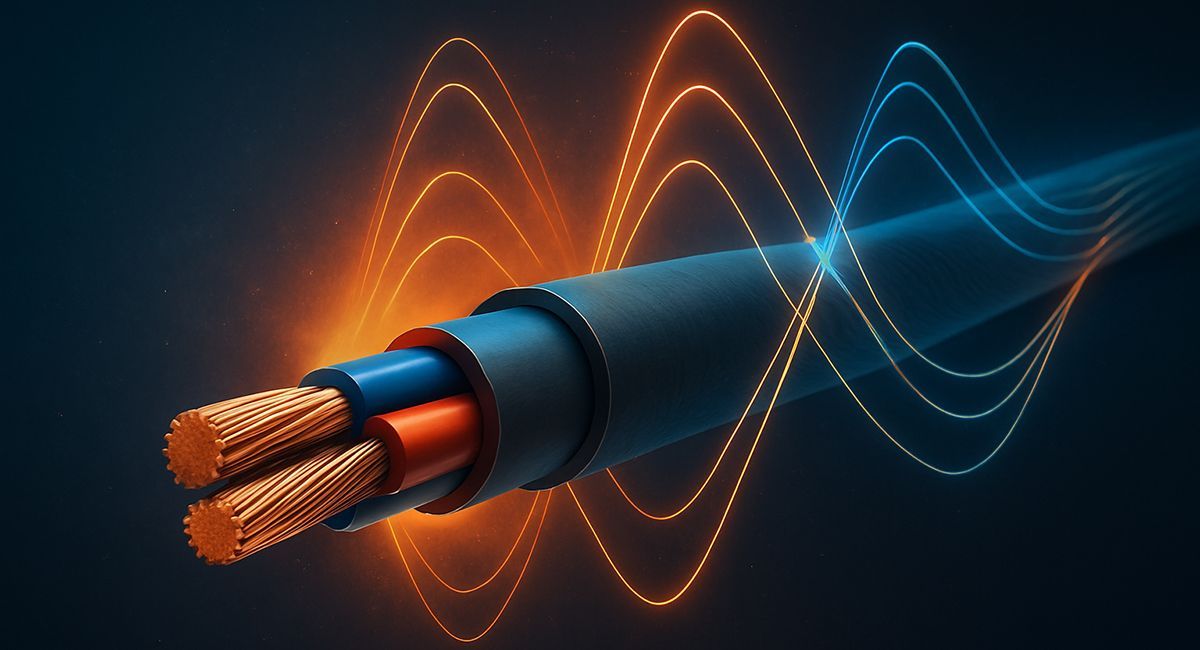
When a voltage is applied to a conductor, it establishes an electromagnetic field around that conductor. Changes in this field propagate along the cable and carry energy and information. Crucially, the majority of this energy exists in the space around the conductor, not inside the metal itself.
This is not audiophile folklore. It is standard electromagnetic field theory and the basis of transmission line physics used in RF engineering, power distribution, and digital communications.
Why Cable Construction Matters at All
Because energy and information propagate in the electromagnetic field surrounding a conductor, anything that influences that field can influence signal transmission.
This includes conductor geometry and spacing, dielectric materials, shielding effectiveness, cable length, and proximity to noise sources.
This does not mean cables add sound or act as tone controls. It means they can influence how cleanly a signal is conveyed, especially when that signal is small, high impedance, or susceptible to interference.
The more fragile the signal, the more this matters.
Power and Signal Follow the Same Physics
Whether a cable is carrying a tiny audio signal or mains power, the physics is the same. The difference is scale.
Large, low impedance signals with high voltage and current are inherently robust. Small, high impedance signals are not. That single fact explains most of the cable debate.
Cable Types and How They Matter
With the above framework in place, we can now look sensibly at each cable type...
• PHONO CABLES
Why They Matter So Much...
If there is one area where cable choice undeniably matters, it is between a turntable and a phono stage.
A phono cartridge produces an extraordinarily small signal, often just a few millivolts, and does so at relatively high impedance. That makes it extremely sensitive to electrical loading and noise.
Two factors are critical:
1. Capacitance and Loading
Every cable has capacitance. In a phono system, that capacitance forms part of the cartridge’s electrical load. Too much, and you alter the cartridge’s high frequency response and resonance behaviour. This can be measured, predicted, and clearly heard.
2. Shielding and grounding
Because the signal is so small, noise pickup becomes a real problem. Poor shielding or grounding can raise the noise floor, introduce hum, or obscure low level detail.
A phono cable is not a passive accessory. It is an electrical component of the cartridge and phono stage system. Change it, and you change the system’s behaviour. This is why phono cables matter more than almost any other cable in audio.
• SPEAKER CABLES
Why the Differences Are Usually Modest...
Speaker cables operate under very different conditions. The signal is strong, the impedance is low, and the system is far less sensitive to interference.
That said, a few factors can still matter.
Resistance
Excessive resistance, typically from thin cables or very long runs, can slightly reduce output and affect damping, particularly with low impedance speakers.
Inductance and capacitance
In most well designed speaker cables, these values are low enough to be irrelevant. In extreme or poorly designed cases, they can interact with certain amplifiers or speakers.
Length and termination
Long runs and poor terminations can introduce small losses or inconsistencies.
What speaker cables do not do is reshape tonal balance or dramatically change a system’s character. When differences are audible, they tend to be subtle and contextual, not transformative.
• LINE LEVEL INTERCONNECTS
Mostly About Not Causing Problems...
At line level, the signal is far more robust than a phono signal, and modern electronics are generally designed to handle it comfortably.
Here, the priorities are simple.
Noise rejection
Poor shielding can allow RF or mains noise into the signal path, particularly in electrically noisy environments.
Balanced vs single ended
Balanced connections reject noise by design and often matter far more than cable brand or price.
Mechanical quality is important here; loose or poorly made connectors can cause intermittent issues that are often misinterpreted as sonic problems. Once these basics are handled properly, a line level interconnect should largely disappear from the equation.
• POWER CABLES
Why the Debate Is So Polarised...
Power cables do not carry audio signals, which is why scepticism here is understandable and necessary.
A power cable cannot alter the audio signal directly, however, it can influence noise coupling, RF ingress, and ground behaviour.
Mains cables can act as antennas, either picking up or radiating noise. In resolving systems, small reductions in noise can manifest as improved clarity or a calmer presentation. These effects are usually subtle, and when they exist, they stem from noise reduction, not signal alteration.
If a power cable appears to transform a system, something else is likely going on.
Why People Hear Different Things
Cables are argued about endlessly because people are listening to different systems, in different environments, with different noise floors, and at different levels of resolution.
Expectation bias exists. So do genuine electrical interactions. Pretending only one of these is real is intellectually lazy.
As systems become more resolving, smaller effects can cross the threshold of audibility. That is not mysticism, it is how thresholds work.
A Calm Conclusion
Cables do not create music, they either preserve it or interfere with it...
Where signals are small and fragile, cable design matters a great deal. Where signals are large and robust, it matters far less. Understanding why removes most of the heat, and most of the nonsense, from the discussion.
Cables are neither snake oil nor salvation, they are engineering choices, best made with context, restraint, and a clear idea of what problem you are actually trying to solve.
Further Reading and Scientific References
For readers who want to explore the underlying science in more depth, the following sources are well established and widely respected.
David J. Griffiths, Introduction to Electrodynamics
This is one of the most widely used undergraduate and graduate textbooks on electromagnetic field theory.
Clayton R. Paul, Analysis of Multiconductor Transmission Lines
A standard reference for understanding how signals propagate via electromagnetic fields in and around conductors.
Paul Clayton, Introduction to Electromagnetic Compatibility
Covers noise coupling, shielding, grounding, and interference, all directly relevant to cable behaviour.
Howard W. Johnson, High Speed Digital Design
Despite the title, this book explains transmission line behaviour in a way that applies equally to analogue audio signals.
MIT OpenCourseWare, Electromagnetics and Transmission Lines
Free university level courses explaining field propagation, signal velocity, and transmission line theory.
HyperPhysics, Signal Propagation in Conductors
A well respected educational resource maintained by Georgia State University.
IEEE Xplore Digital Library, Transmission Line Theory
Search terms such as “electromagnetic field energy transmission” or “transmission line propagation” will return peer reviewed papers backing the concepts used in the article.
Key Concept Summary (for sceptics)
If someone challenges the article’s foundation, the specific concepts to look up are:
- Electron drift velocity
- Poynting vector
- Transmission line theory
- Electromagnetic field energy propagation
- Signal to noise ratio
All of these are standard physics, taught at undergraduate level, and are not audiophile specific ideas.
These sources all describe the same underlying reality. Electrons drift slowly, electromagnetic fields propagate energy, and cable behaviour is governed by field interaction, not mythology.
